Showing posts with label fly ideas. Show all posts

Sunday, April 07, 2013


    This topic explains you the basics of aerodynamics and airplane parts. A lot more goes on behind the scenes when you fly your RC Airplane. Understanding the basics of aerodynamics and airplane parts can really help you gain the mastery in flying your Electric RC Airplane.
Why do you need to learn Basics of Aerodynamics to fly your RC Airplane?
The key difference between the experts and amateurs is that the experts understand their material from "inside-out".
If you enjoy flying your RC Airplane, you need to master these material to become an expert at flying it. Not understanding this material would make the art of flying as something very complex and difficult. Not understanding this material would make you feel like an outsider, merely using your RC Airplane as a toy. If you want to get good at flying it, you need to consider this as an art, not a hobby.
You don't need to be a science geek to understand it - it is presented in a fairly simple language and if you are attentive, you will really enjoy reading this material.
Here we go...Enjoy!
Parts of Airplane
Airplane can be divided into five main parts: Fuselage, Wing, Empennage, Powerplant, and Landing Gear. Each of these five parts have their own functions.
Fuselage is the central component of airplane - the other parts are usually attached the fuselage.
Wings make the aircraft fly - they generate essential force called "lift" that makes the airplane fly. Airplanes with single set of wings are known as monoplanes, whereas the ones with two sets are called biplanes. Wings contain two other parts of airplane known as aileron and flaps. Ailerons move in opposite direction and cause the airplane to roll. Flaps, when moved downwards, extend the lifting force during take-offs and landings.
The Empennage includes vertical stabilizer, horizontal stabilizer. Rudder is attached to the end of vertical stabilizer, whereas elevator is attached to the end of horizontal stabilizer. Rudder helps to move the plane left or right, whereas elevator is used to move the airplane up or down.
Landing Gear supports the airplane and absorbs the loads during landing. Landing gear mainly consists of three wheels, two main wheels located on the either side of the fuselage and a third wheel located either at the front or the back of the Airplane.
Powerplant includes engine and propeller. The main job of engine is to provide the power to turn the propeller which in turn translates the rotating force of engine into the forward-acting force known as thrust to help move the airplane forward in the air.
Forces Acting on Airplane
The four forces acting on airplane at any given time are Lift, Weight, Drag, and Thrust. In straight and level un-accelerated flight, lift equals weight and thrust equals drag.
What makes Airplane Fly?
In order to understand what makes airplane fly, we need to understand a simple scientific principle. Don't be too intimidated, this principle is fairly simple.
Bernoulli's principle states that "as the velocity of fluid increases, its internal pressure decreases." Surface of wing when interacts with the airstream, it generates lift.
The air moves a lot faster from the upper surface of the airfoil, which causes lower air pressure on top, whereas, low-velocity air flow through the bottom of the airfoil causes high pressure at the bottom of the airfoil. This difference in pressure is what causes the force of lift - that's how airplanes fly.
Aircraft Axes of Flight
There are three axes of flight: Longitudinal, lateral, and vertical axes. These three axes have a common reference point known as the center of gravity.
When the aileron's move, they cause rolling movement along the longitudinal axis of airplane. When the elevator's move, they cause pitch up or pitch down movement along the lateral axis of airplane.
When the Rudder moves, it causes rotational movements along the vertical axis of airplane.


Article Source: http://EzineArticles.com/1547464

Wednesday, March 27, 2013

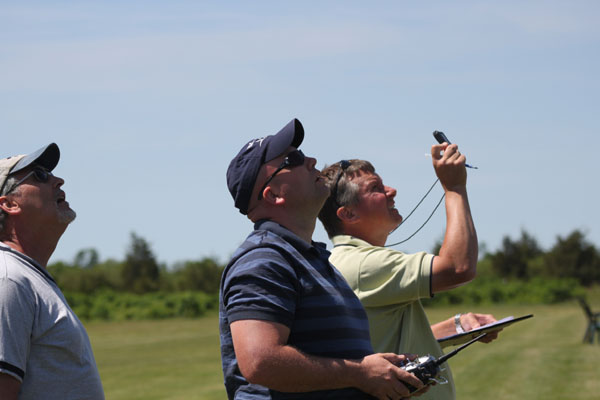
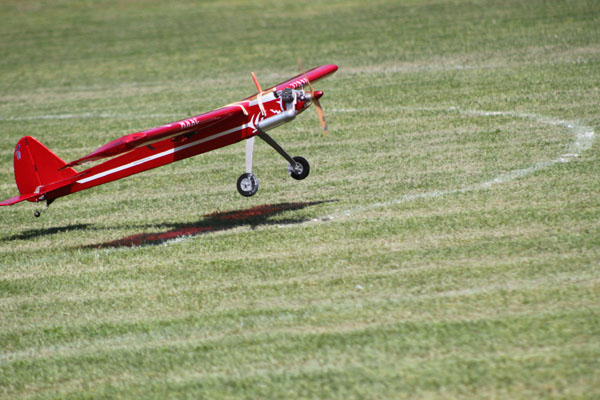
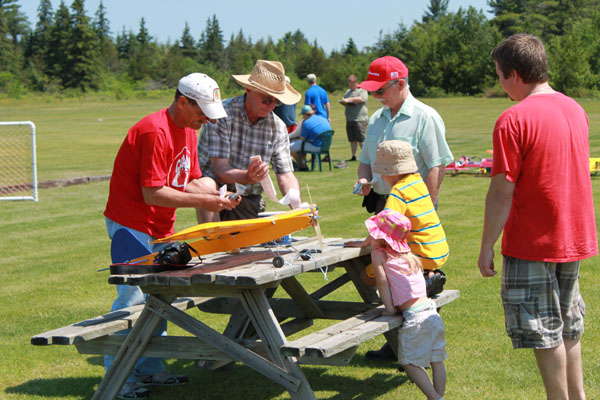
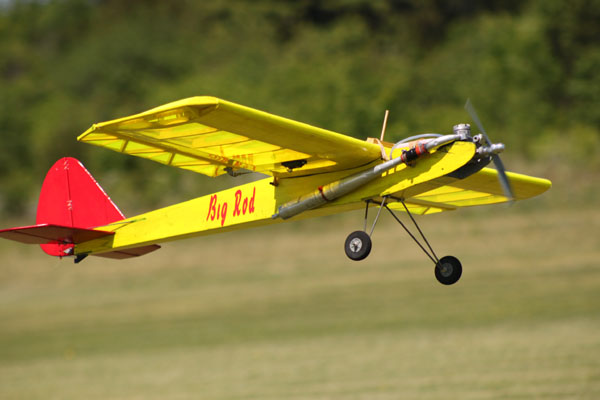
If you don’t know what a ”FUN FLY” event is, then you are missing out on some real excitement! Fun flys are exciting,  fun and help improve you piloting skills! What do you need, to join in? Well, the definition of a Fun Fly plane is typically any plane that has improved flight performance to execute specific aerobatic tasks in a timed event. But you don’t really need a high-performance plane to do fun fly tasks. The scope of events and maneuvers is very broad and you can even use your old beat up trainer. Adding a stop watch makes it competitive.
For the more dedicated, you can increase the airplanes power, and increase its control surfaces to make it more responsive and faster.
So here are some events and descriptions of popular tasks you can use to add fun to your flying.
  • Timed flight. Without outside help or a timer on the radio, take off and fly around. After a give period of time (1 minute or 2) come in to land. The closest time to wheels touchdown (without going over) is the winner. Propeller must still be spinning after the landing to count.
  • Timed loops. This is great for beginners as it is started and finished in flight so no rushing to takeoff. Fly straight and level and then when the stop watch is started, do as many loops as you can in one minute. The most loops win.
  • Dice Takeoff & Loops. Roll the dice, takeoff and do that number of loops and land. The shortest time wins. This a great chance equalizer, a novice can throw a low number and an experienced flyer can throw a high number, so the novice can easily win. A special version allows anyone to participate is for new student pilots (or family members,) an instructor takes off and lands, and the student does a single loop.
  • Triple Loops & Rolls. Takeoff do 3 rolls and 3 loops then land. Best time wins. Loops and rolls can be in any order.
  • Timed Dead-stick Spot Landing
  • Pilot has set time for engine run, (30 seconds, 45 seconds, 1 minute, etc.,) then the engine is shut down and the pilot tries to stay up as long as possible and then do a spot landing. The engine must be shutdown with throttle stick and trim. A single club trainer that everyone flies is the best situation but it is pilot choice. Longest flight wins and spot landings (closest to a target) is used for tie breakers.
  • Timed Glide. Similar to the above event, with the exception that the engine is set to idle after a certain amount of time and then it is glided for as long as possible until the throttle is applied again which stops the timer.
     Timed Inverted Flight is another easy one to try. After the wheels leave the ground, the pilot starts the clock by flipping the model upside down and he flies for a given amount of time. 1 minute or 2, 3 what ever is appropriate for the pilots. If he reaches the cut off time, he is awarded maximum points. Less time give less points. Spot landings are used as tie breakers.
  • Spot Landing. Paint a line across the centerline of the runway and then paint two more parallel lines, (one on either side of the target line,) about 10 or 15 feet apart. Each pilot gets three attempts to land (touchdown,) as close to the middle line as possible. After the three tries, and the plane stops (with propeller spinning), the score is counted. Touching on the middle line is worth 50 points, touching down with on the two outer lines is worth 25 points and just touching down outside of the target lines is worth 5 points. Highest score wins. (Ties are broken by shortest time.)
 
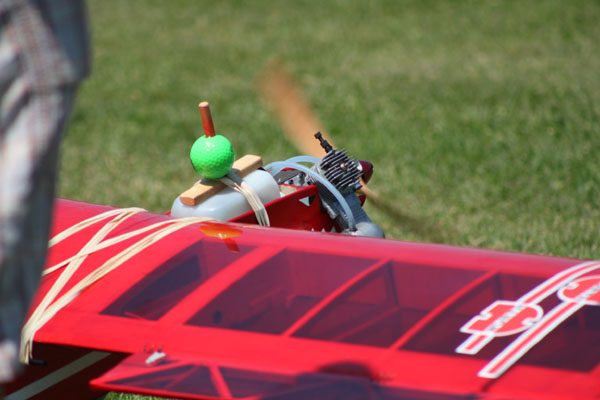
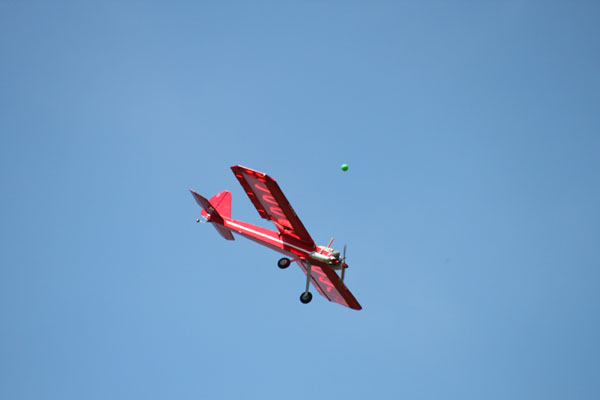
  • Golf Ball Bomb Drop. This is borrowed from the gang of the Kingston RC Modelers Club in Kingston, Ontario, Canada. Take off and make a bomb run over a 50 foot diameter circle target divided into three bull’s eye circular rings. The smallest (10 feet diameter) is 50 points, the middle circle (30 foot diameter) is 25 points and the outer ring is 10 points. Just hitting the flying field with the ball is a successful attempt and earns 5 points. A spot landing ending within the target (with the prop still spinning) doubles the bomb drop score.  The club supplies the balls and dowel holding fixture that is attached to the airplane with rubberbands. Simply blipping some down elevator throws the ball off the dowel. Or, the plane can do a roll to inverted to release the ball.
 
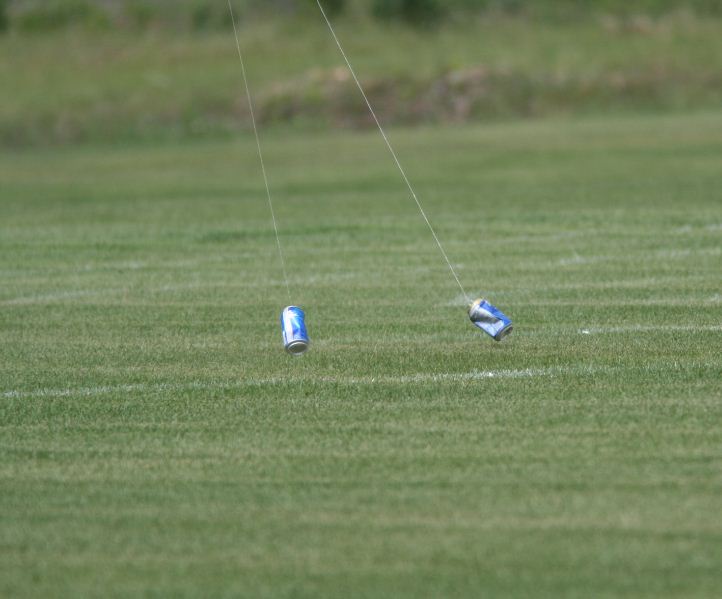
  • Can Can. Tie an empty soda can (or two!)  to a 50 foot length of fishing string and tie the string to the tailwheel of the airplane. Fly the airplane in such a way as to touch the can down onto a 50 foot circle target. Hint: fly past the target and then do a quick 180 degree turn. As the plane reverses direction, the can falls from the air. Three tries are allowed. Highest score wins and lowest time is used for tie breakers.
  • Kingston Roops. This is another timed event originating at the Kingston Father’s Day Fun Fly. Time starts  at liftoff then the pilot does a sequence of a loop and then a roll. He does this three times and then comes in for a landing to stop the clock. Lowest time wins and a spot landing (with prop still spinning,) on a target can be worth bonus points.
So there are many, many other fun fly event ideas that clubs have come up with but these are some of the more popular. Give them a try and if you ask why? …The answer is twofold. First, competition helps improve a pilots flying skills and two, getting friends and club members together at the flying field is always good fun! Bringing a tent and a BBQ are always optional. All that’s really required is some spray paint (or powdered chalk,) a few stop watches and some club members to act as line judges and timers. Give it a try! You will have fun!!!
Photos by Ken Park — Words by Gerry Yarrish
Subscribe to RSS Feed Follow me on Twitter!